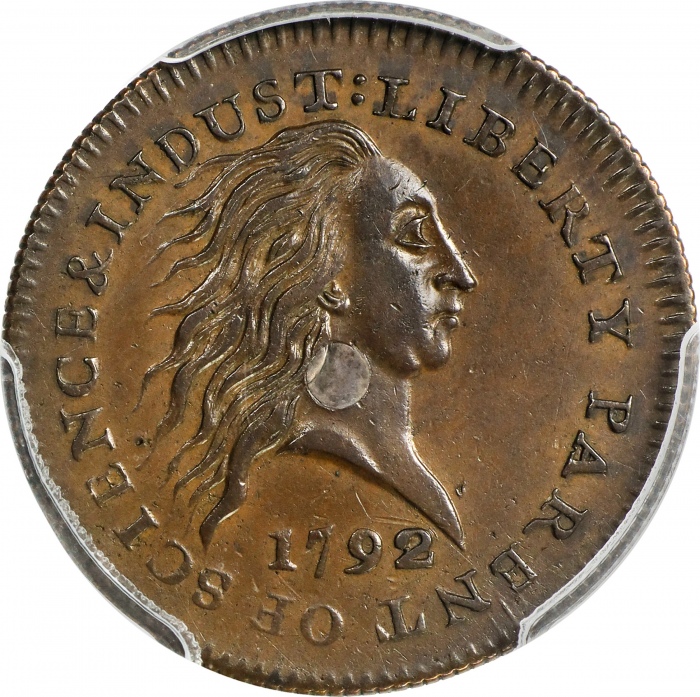
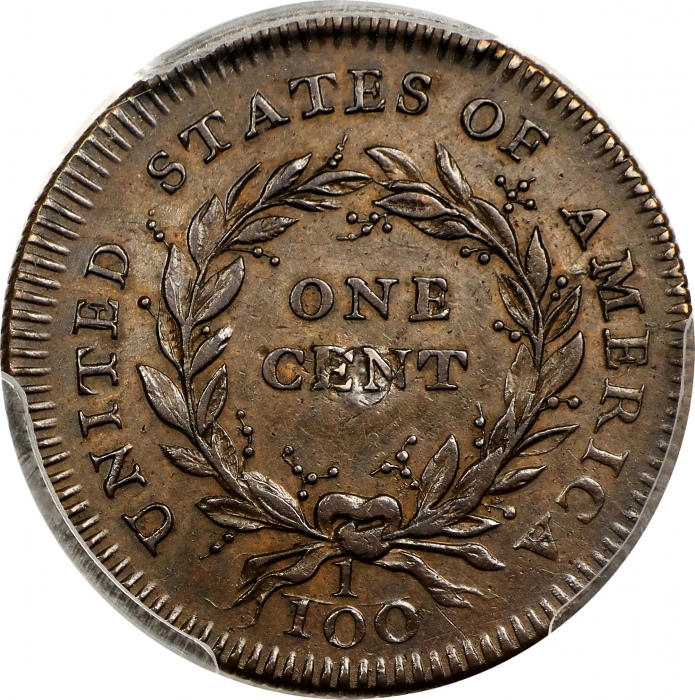
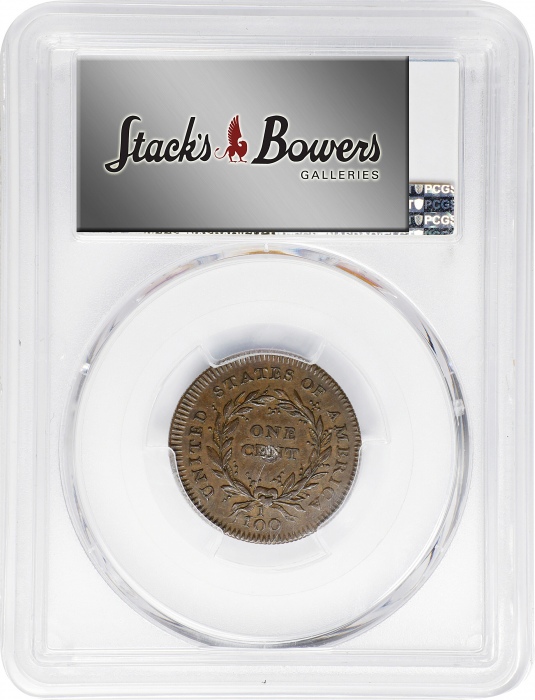
1792 Cent. Silver Center. Judd-1, Pollock-1. Rarity-6+. Copper with Silver Plug. Reeded Edge. MS-61 BN (PCGS). CAC.<strong>Since our last offering of this coin (November 2017 Baltimore Auction, lot 10003), its status as a genuine Judd-1 Silver Center cent has been called into question through research conducted by Robert Rodriguez, Tony Lopez, Stuart Levine and Maureen Levine. This team of researchers conclude that the Morris specimen of Judd-1 offered here is a genuine Judd-2 cent with the silver plug added at a later time to simulate a Judd-1 example. Their findings are summarized in a video hosted by Robert Rodriguez for the 2020 Newman Numismatic Portal Symposium, which is available at the following link: https://nnp.wustl.edu/library/book/588141. Prospective bidders on this lot are encouraged to familiarize themselves with the research done and conclusions put forth by Mr. Rodriguez and his colleagues. However, S</strong><strong>tacks Bowers Galleries is offering this coin as certified by PCGS and verified by CAC - in other words, as a genuine Judd-1 Silver Center cent certified as PCGS/CAC MS-61 BN.</strong><p>We continue with our description of this coin as presented in our November 2017 Baltimore Auction offering, with minor updates.<p><strong>Obv:</strong> A bust of Liberty faces right, with flowing hair curls, the legend LIBERTY PARENT OF SCIENCE & INDUST: around the border and the date 1792 tucked in below the truncation, yet above the letters NT and OF in the legend. <strong>Rev:</strong> An open laurel wreath with fruit on strings and tied with a ribbon with bow surrounds the denomination ONE / CENT. The legend UNITED STATES OF AMERICA is around the border and the denomination 1/100 is below the wreath stems. Rich glossy chocolate brown surfaces retain some mint luster and lighter brown toning highlights the devices and legends where original mint color was last to fade. Some steel toning is apparent on the reverse, and the silver plug retains an attractive blend of light and dark gray. A dull horizontal mark above the final digit of the date serves as the primary identifying defect, along with a round impact above the fifth lock of hair from the bottom and a vertical hairline along Libertys hairline. The obverse centering is shifted slightly southwest, leaving long elegant denticles at the northeast quadrant and a somewhat shorter and softer border near the base of the obverse. The reverse is ringed with a handsome border all the way around, though the denticles are longer at left than right. The strike is bold, the detail excellent, and the overall visual impression is overwhelmingly positive, a match for the exceptional desirability of this historic specimen.<p>There are only 12 or 13 known specimens of the 1792 Silver Center cent, one of the most famous American rarities from this first year of United States coinage or any other. This issue was ranked 35 among <em>The 100 Greatest U.S. Coins</em> by Garrett and Guth (fifth edition, 2019). It was chosen to illustrate Breens 1988 <em>Encyclopedia of United States and Colonial Coins</em>. Traceable to the 1905 sale of the collection of Charles Morris of Chicago, this example is perhaps best known as the cover coin of the 1974 GENA catalogue by Pine Tree Rare Coin Auctions. While it is unknown exactly where Morris acquired this piece, past cataloguers have suggested it is the William J. Jenks specimen, first presented by W. Elliot Woodward in 1880, the first of three offerings by him that decade. The authors of <em>1792: Birth of a Nations Coinage</em> have linked the Woodward offerings to the Mickley-Cohen specimen, an NGC VF-30. Morris, a Welsh emigre who became a fireworks magnate, began collecting in the 1850s, amassing an impressive cabinet of Canadian and early American rarities. He was member number 38 of the American Numismatic Association.<p>By the time this coin sold in the 1905 sale of the Morris collection, the remarkable story of the 1792 Silver Center cents was already well known. Sylvester Crosby described the Parmelee specimen in his 1875 work <em>The Early Coins of America</em> and knew about the Appleton piece, earlier ex. Mickley-Cohen. James Ross Snowden had described the Silver Center cents as early as 1860, but its uncertain what researcher was the first to discover this coins intimate connection to Thomas Jefferson and the origins of the American monetary system.<p>Any great historical object benefits from a paper trail, and perhaps no early American coin has a longer and more impressive paper trail than the Silver Center cent. The trail starts before the founding of the U.S. Mint, in the casual correspondence between the man whose brainchild the Silver Center cent was long thought to be and the man whose brainchild it actually was. Thomas Paine wrote to Thomas Jefferson on September 28, 1790, soon after Jeffersons April 1790 Report on Copper Coinage and his July 1790 report on Weights, Measures, and Coinage, which espoused a thoroughly interconnected decimal-based system. Into this conversation, Paine interjected some thoughts on how to give fractional coins real value:<p><em>"Of compositions, three methods present themselves -- 1st. Mixing silver and copper in fusion -- 2d. Plating the copper with silver -- 3d. Plugging the copper with silver. But against all these there are very capital objections. -- Wherever there is a want of satisfaction there must necessarily be a want of confidence; and this must always take place in all compounded metals. There is also a decrease in the intrinsic value of metals when compounded; one shilling worth of silver compounded with one shilling worth of copper, the composition is not worth two shillings, or what the metals were worth before they were compounded, because they must again be separated to acquire their utmost value, and this only can be done at a refiners. It is not what the coin cost to make, but what the coin is intrinsically worth when made; that only can give it currency in all cases. Plugging copper with silver is the least detrimental to the intrinsic value of the metals, because they are the easiest separated; but in all these cases the value of the silver put into the composition will be so predominant to the value of the copper, that it will be rather a base silver coin than a copper coin."</em><p>Paine suggested a fiat currency, with no consideration of the intrinsic value of the copper coin, made more economic sense: "It is convenience only that ought to be considered with respect to copper coinage, and not money or riches." Jefferson apparently disagreed. He wrote back almost a year after Paine had sent his note, on July 29, 1791, explaining that he hadnt received the letter until February and figured he would see him that spring. He suggested that Paine publish his observations (which was done, possibly with Jeffersons assistance) but otherwise tabled the discussion, saying:<p><em>"Your observations on the subject of a copper coinage have satisfied my mind on that subject, which I confess had wavered before between difficulties. As a different plan is under consideration of Congress, and will be taken up at their meeting, I think to watch the proper moment."</em><p>With that, Jefferson apparently put the conversation out of his mind until late 1792, when a copper coin plugged with silver, just like Paine had suggested, was struck at the First United States Mint in Philadelphia. Presumably the suggestion for their construction had come from Jefferson, though Jefferson offers the credit to the Mints coiner, Henry Voigt. Jefferson wrote to George Washington on December 18, 1792, enclosing two coins just like the one here offered:<p><em>"Th. Jefferson has the honor to send the President 2 cents made on Voigts plan, by putting a silver plug worth 3/4 of a cent into a copper worth 1/4 of a cent. Mr. Rittenhouse is to make a few by mixing the same plug by fusion with the same quantity of copper. He will then make of copper alone of the same size, and lastly he will make the real cent, as ordered by Congress, four times as big. Specimens of these several ways of making the cent will be delivered to the Committee of Congress now having that subject before them."</em><p>Jefferson and Rittenhouse had gone about producing cents using two of the three methods Paine had suggested. They were pleased enough that they sent specimens of this particular type (and maybe the others, though the paper trail on that question is silent) to President Washington. They would have also sent Silver Center cents to the members of the "committee...to prepare and report a bill to amend the act establishing a Mint and regulating the coins of the United States, so far as respects the copper coinage," named on November 30, 1792 as Rep. Hugh Williamson of North Carolina, Rep. John Page of Virginia, and Rep. John W. Kittera of Pennsylvania. Williamson was a native of Chester County, Pennsylvania, a former mathematics professor and a physician. John Page was a college chum of Thomas Jeffersons and served as his lieutenant governor during the Revolution. Kittera was a Princeton-educated lawyer. No mintage figure has ever been published, or even guessed at, but we can identify two sent to Washington and one to each of these three gentlemen. Perhaps they each received two or more. Given that 12 or 13 survive, the mintage could have been as high as 50 or more.<p>Today, any example of this issue is a prize. About half show significant wear, ranging from nearly slick to the EF/AU level. The Smithsonian specimen shows little wear but has a substantial area of roughness on the reverse. Three specimens are clearly finer than the PCGS/CAC MS-61 BN specimen offered here, ex. Garrett, Norweb, and Newman; two others are of similar quality, ex Bushnell-Brand and Weinberg. This pieces storied provenance, appearances in standard references, and superb visual appeal rank it in the top flight of survivors of the United States Mints rare and historic coinage of 1792.PCGS# 11001. NGC ID: 2948.PCGS Population: 1, 2 finer (Specimen-67 BN finest).<p>CAC Population: 1; 1.From the Cardinal Collection Educational Foundation. Earlier ex Charles Morris Collection, before 1905; S. Hudson and Henry Chapmans sale of the Charles Morris Collection, April 1905, lot 361; unknown intermediaries; James O. Sloss Collection; William Mitkoff and Numismatics, Ltd.; Pine Tree Rare Coin Auctions 1974 GENA sale, September 1974, lot 1272a; William T. Anton, Jr.; Liberty Collection; Heritages sale of April 2012, lot 5403; John Albanese, Kevin Lipton, and Anthony Terranova.









关于 1792年中心银美分 PCGS MS 61 1792 Cent. Silver Center的评论